
Center point


Overview
Mecanum’s Center Point measures the Young’s modulus, shear modulus, and structural damping factor of elastic and viscoelastic materials. It works by measuring the entry mobility of a free-free beam excited at its center, a method well suited to characterizing damping treatments used to control structural noise and vibration. Paired with an optional climatic chamber, it captures how these properties change with temperature and frequency. It follows ISO 16940, SAE J3130, and JIS G 0602.
Both WLF nomograms and 3D property surfaces
Viscoelastic properties depend heavily on both temperature and frequency. The Center Point software captures this behavior and presents it two complementary ways, so you can work in whichever format fits your needs.
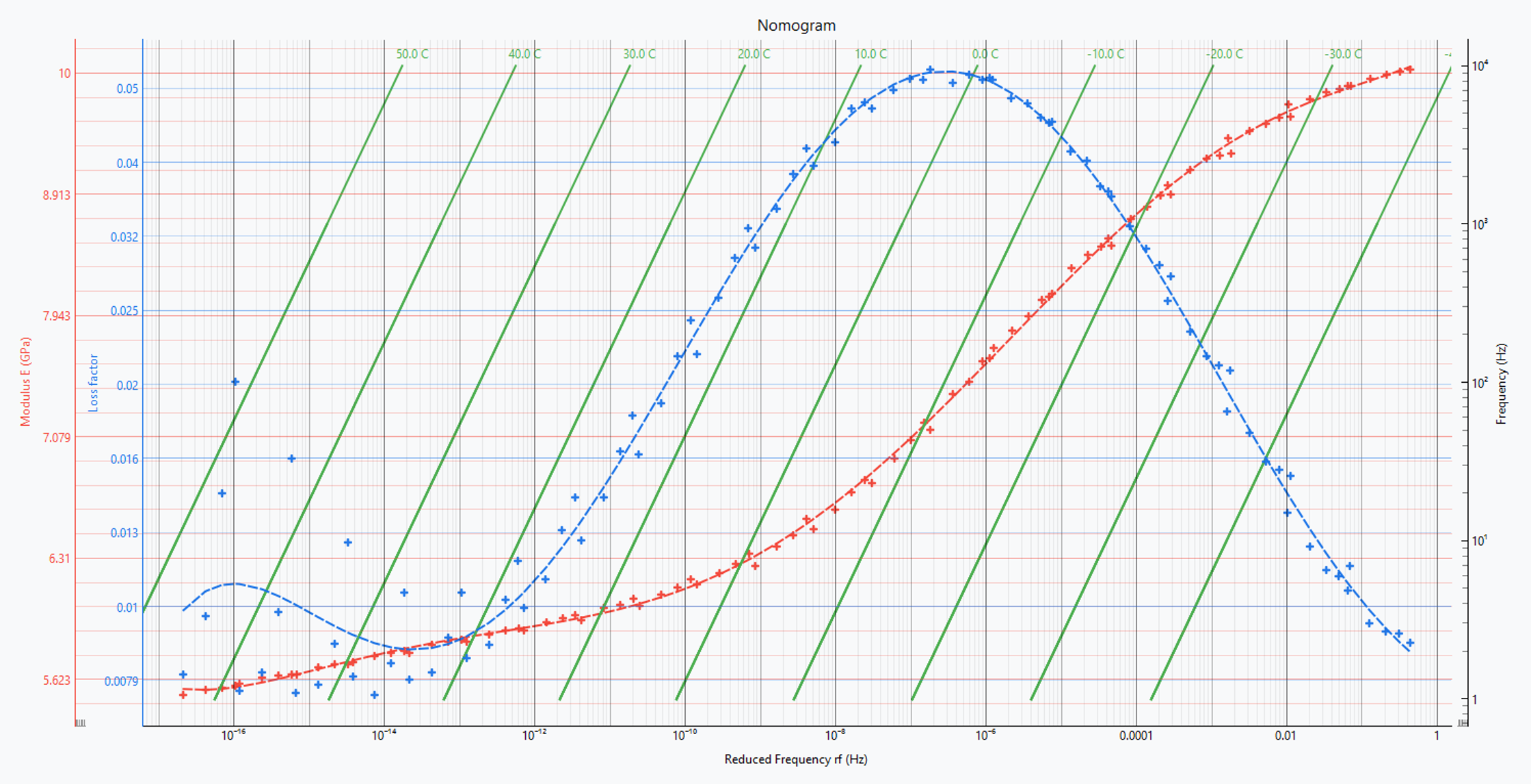
The Williams-Landel-Ferry (WLF) nomogram gives you the standardized, widely recognized representation expected across the industry and by many clients.

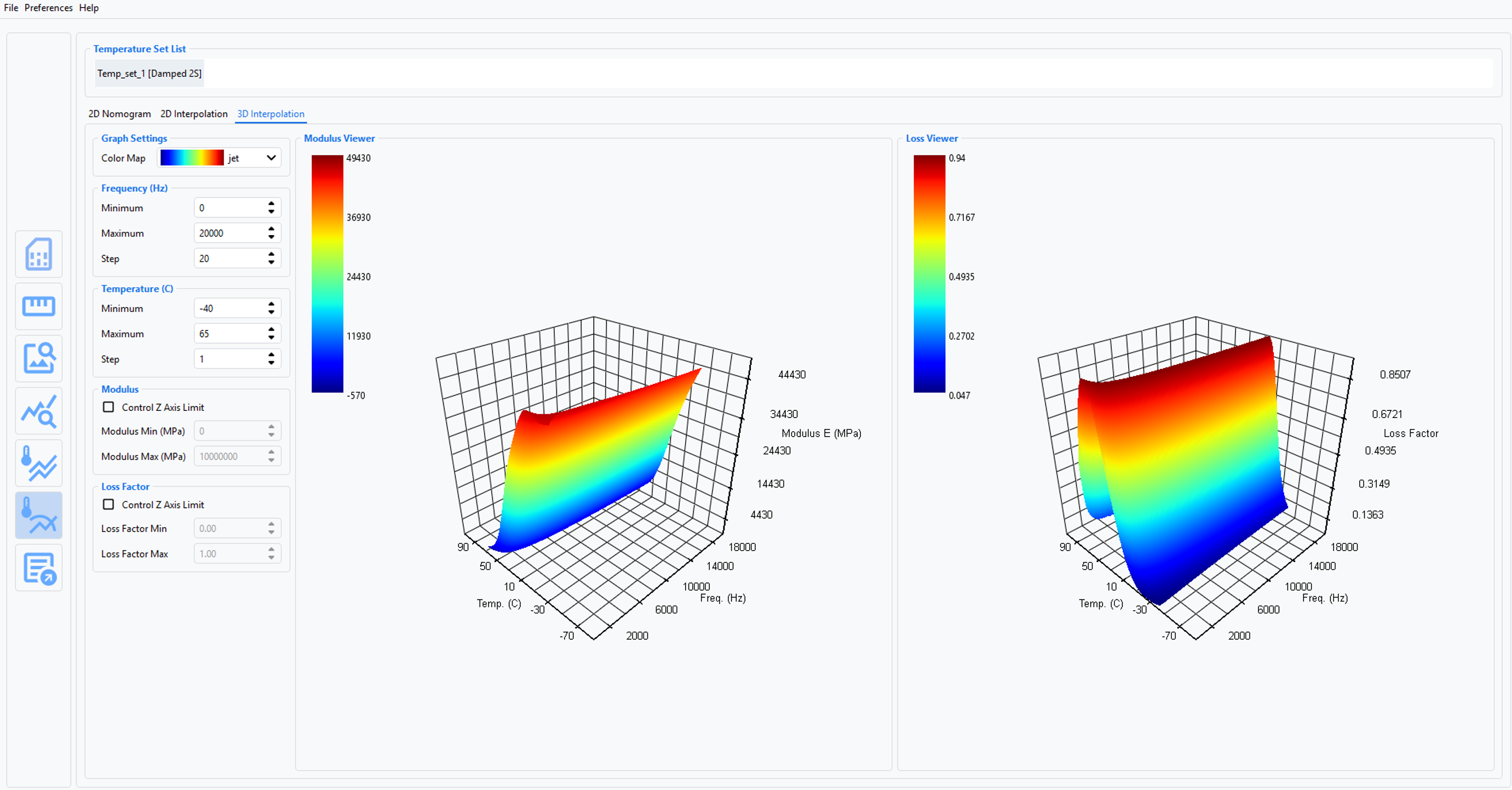
The 3D property surface plots temperature, frequency, and the key property, Young’s or shear modulus and damping, on a single shape for an immediate, comprehensive read. Same measurement, two views: the reference format and the intuitive one.

Measuring range
Frequency
5 to 5000 Hz
Operating temperature
0 °C to 60 °C
Maximum excitation force
31 N
Damping and structural loss factor, Young’s and shear modulus
No limitations, depends on beam characteristics
Dimensions
Test bench
150 (L) x 150 (W) x 200 (H) mm
Beam length range
135 to 315 mm
Maximum sample height
30 mm
Measured properties
Young’s modulus (E) or shear modulus (G)
Damping loss factor (η)
ETA-X
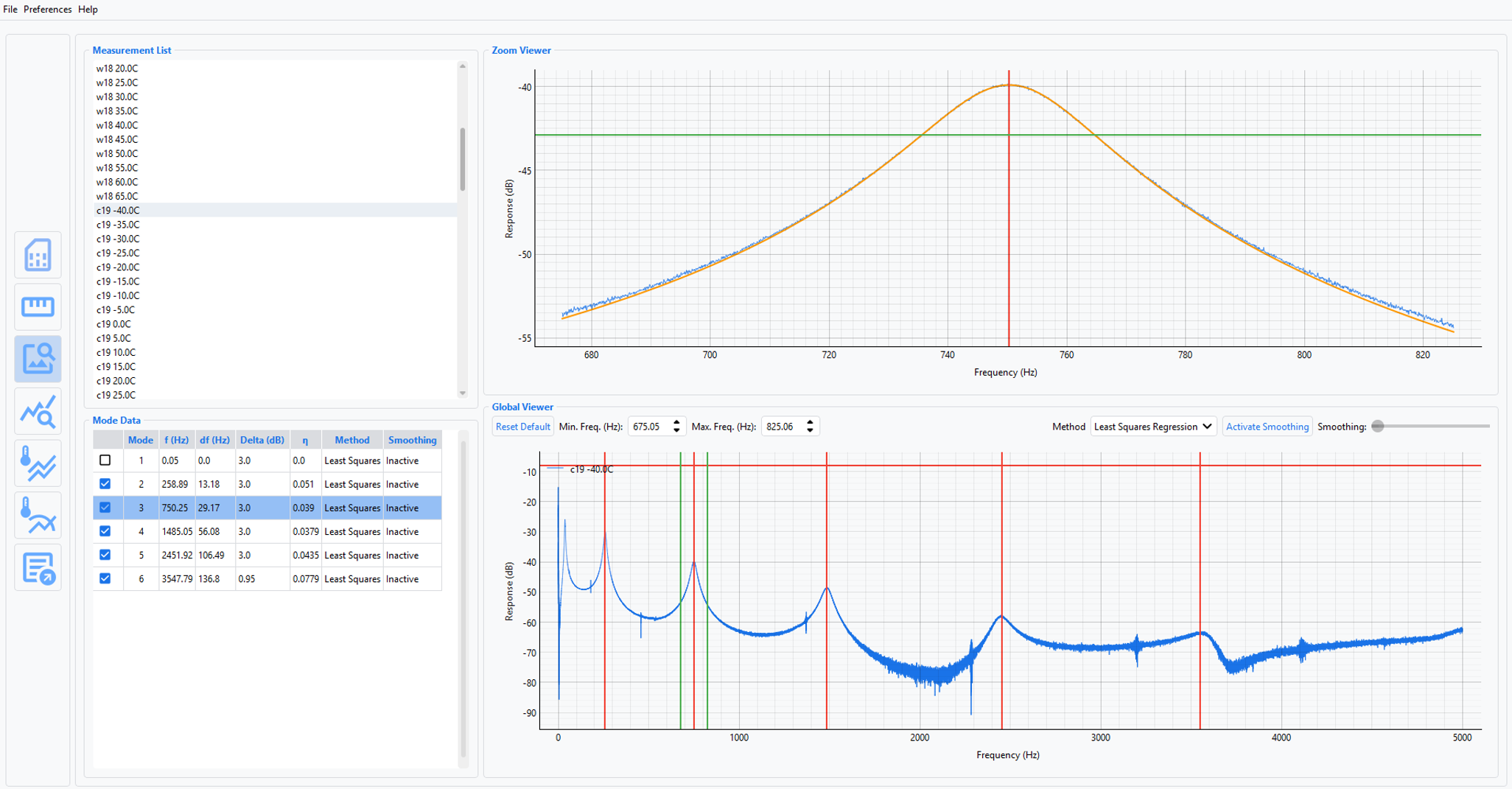
Loss factor measurement is traditionally long and complicated. ETA-X puts decades of damping-measurement experience at your fingertips, guiding you from the beam measurement through advanced pre-processing to finished documentation in a clear workflow. Its semi-automatic analyzer mode saves significant time, and fully automated measurement lets you cover wide temperature ranges at high resolution, across up to three test benches, while you do something else. A broad set of visualization tools handles different standards and materials, a built-in nomogram generator supports ISO, WLF, and Arrhenius alpha functions, and a one-click Excel report compliant with ISO 16940, SAE J3130, and JIS G 0602 comes complete with built-in graphs.


Coming soon.
Automotive industry
Characterize damping treatments that cut structural noise, squeaks, and rattles in vehicle bodies and panels.
Aerospace industry
Measure the modulus and damping of viscoelastic materials used to control structural vibration in aircraft.
Laboratories
Measure modulus and damping factor across temperature and frequency for reliable, repeatable viscoelastic data.
Universities
Study the viscoelastic behavior of elastic and damping materials with a standards-based free-free beam method.
Optional accessories, available with your Center Point or separately.
Climatic chamber
Damping materials are viscoelastic, so their performance shifts with temperature, sometimes dramatically. Measuring at room temperature alone tells only part of the story. The optional climatic chamber lets the Center Point characterize a material across its full operating window, so you see how it behaves at the temperatures it will actually meet in service, not just on the bench.
The chamber controls both temperature and humidity around the test beam, holding stable conditions while the measurement runs. Combined with the bench’s frequency sweep, this gives you damping loss factor and modulus as functions of both temperature and frequency, the complete data set needed to model viscoelastic behavior and to match a damping solution to its application.
Key points:
• Controlled temperature across the bench’s full operating range, from 0 to 60 °C.
• Humidity control for stable, repeatable test conditions.
• Integrates directly with the Center Point test bench.
• Pilots up to 3 test benches simultaneously.
• Enables temperature-frequency characterization and 3D property surfaces.