
High level impedance tube


Mecanum’s high level impedance tube measures the key acoustic indicators of a wide range of materials using 2, 3, or 4 microphone methods. In its in-situ configuration, it is built to measure the surface impedance of aeronautical liners and perforated plates at high sound levels, up to 155 dB, where their acoustic behavior becomes non-linear. Working from small 29 mm samples over a 300 to 6300 Hz range, it follows ASTM E1050, ASTM E2611, and ISO 10534-2.
Performance
Frequency range
300 to 6300 Hz
White noise or sine sweep excitation
Up to 155 dB
Hard wall measurement (zero absorption)
All ⅓ octave until 4 kHz < 4 %
⅓ octave 5 kHz and above < 10 %
Dimensions & sample size
Dimensions
In-situ 2 microphones: 350 (L) x 170 (W) x 190 (H) mm
3 microphones: 890 (L) x 170 (W) x 190 (H) mm
4 microphones: 1140 (L) x 170 (W) x 190 (H) mm
Max sample thickness
2 microphones absorption: 250 mm
3 microphones transmission: 220 mm
4 microphones transmission: 125 mm
Sample diameter
29 mm
Measured properties
Tube-X
Tube-X guides you through normal-incidence absorption and transmission loss measurement in a single, intuitive window, clear enough to be productive from the first use. It supports all 2, 3, and 4 microphone methods alongside advanced research features, and lets you save raw data to run your own post-processing. Built-in tools take measurements further, averaging, smoothing, merging curves across frequency ranges, adding an air cavity, comparing projects, and a one-click, ISO/ASTM-ready Excel report turns results into professional documentation.
On the high level impedance tube, Tube-X adds capabilities for demanding campaigns: create test-campaign templates to automate large measurement sets without missing a step, run in-situ and grazing-incidence testing (with the appropriate hardware), use swept-sine excitation and acoustic-center measurement, and read the acoustic particle velocity directly at the sample surface.

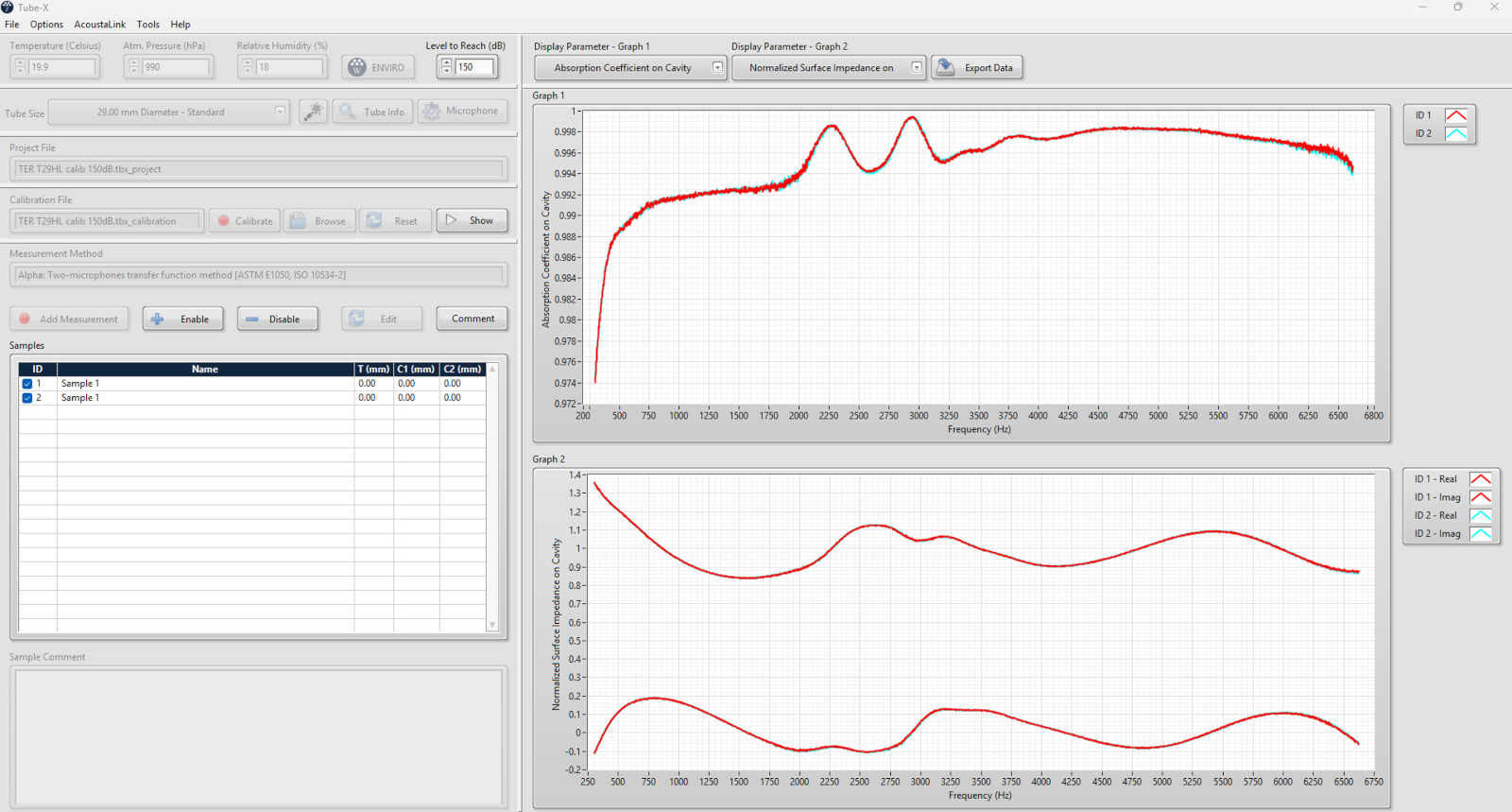
Coming soon.
Aerospace industry
Measure the surface impedance and non-linear behavior of engine liners and perforates at levels up to 155 dB.
Laboratories
Run in-situ, high-level impedance measurements on liners and perforates under realistic operating levels.
Universities
Investigate non-linear acoustic effects and high-amplitude behavior that standard tubes cannot reveal.
Optional accessories, available with your high level tube or separately.
Circular knife
The circular knife lets you cut clean, repeatable sample geometries from porous materials, so each specimen fits the tube precisely and edge effects stay minimal. Consistent sample preparation is one of the simplest ways to improve measurement repeatability.
Material slicer
The material slicer holds a porous sample firmly in place while you cut it to thickness, giving you flat, parallel faces and a controlled height. It removes much of the guesswork from preparing soft or compressible materials that are otherwise hard to slice evenly.
Weather station
The weather station measures the ambient temperature, pressure, and humidity at the moment of testing, the atmospheric conditions that influence the speed of sound and, in turn, your acoustic results. Logging them alongside each measurement keeps your data accurate and traceable.
Muffler adapters
The muffler adapters connect mufflers and similar components directly to the tube, so you can measure their acoustic indicators as complete assemblies rather than as material samples. They open up transmission loss and impedance testing on real exhaust and silencer parts.