
Quasi-static mechanical analyzer


Mecanum’s quasi-static mechanical analyzer measures the Biot elastic properties of porous materials: Young’s modulus, Poisson’s ratio, and damping loss factor. These mechanical parameters govern how a porous frame deforms and dissipates energy, and they are essential inputs for accurate acoustic modeling of absorbing and damping materials. A simple, software-guided procedure makes the quasi-static mechanical analyzer well suited to end-of-line quality control, supplier validation, and new material development. It follows ISO 18437-5.
Dimensions
Test bench
460 (L) x 485 (W) x 400 (H) mm
Sample diameter
29 to 100 mm
Sample height
5 to 50 mm
Measuring range
Young’s modulus
300 Pa to 34 MPa (depends on material diameter)
Poisson’s ratio
0 to 0.4999
Damping loss factor
0 to 0.999
Frequency
20 to 60 Hz
Measured properties
Young’s Modulus (E)
Poisson’s Ratio (ν)
Damping (or loss) factor (η)
QMA-X
With its single-window interface, QMA-X guides you from system calibration through to data post-processing, with smart tools that make the work easier, clear enough to be productive from the first use. Because every material behaves differently, the software can run stiffness-versus-compression tests so you’re never measuring blindly, confirming that your results are valid for the sample at hand. Calibration is quick and straightforward, so you always start on solid footing, and a smart post-processing tool detects compatible sample pairs and helps you fine-tune your results. A one-click report turns everything into clear, professional documentation.

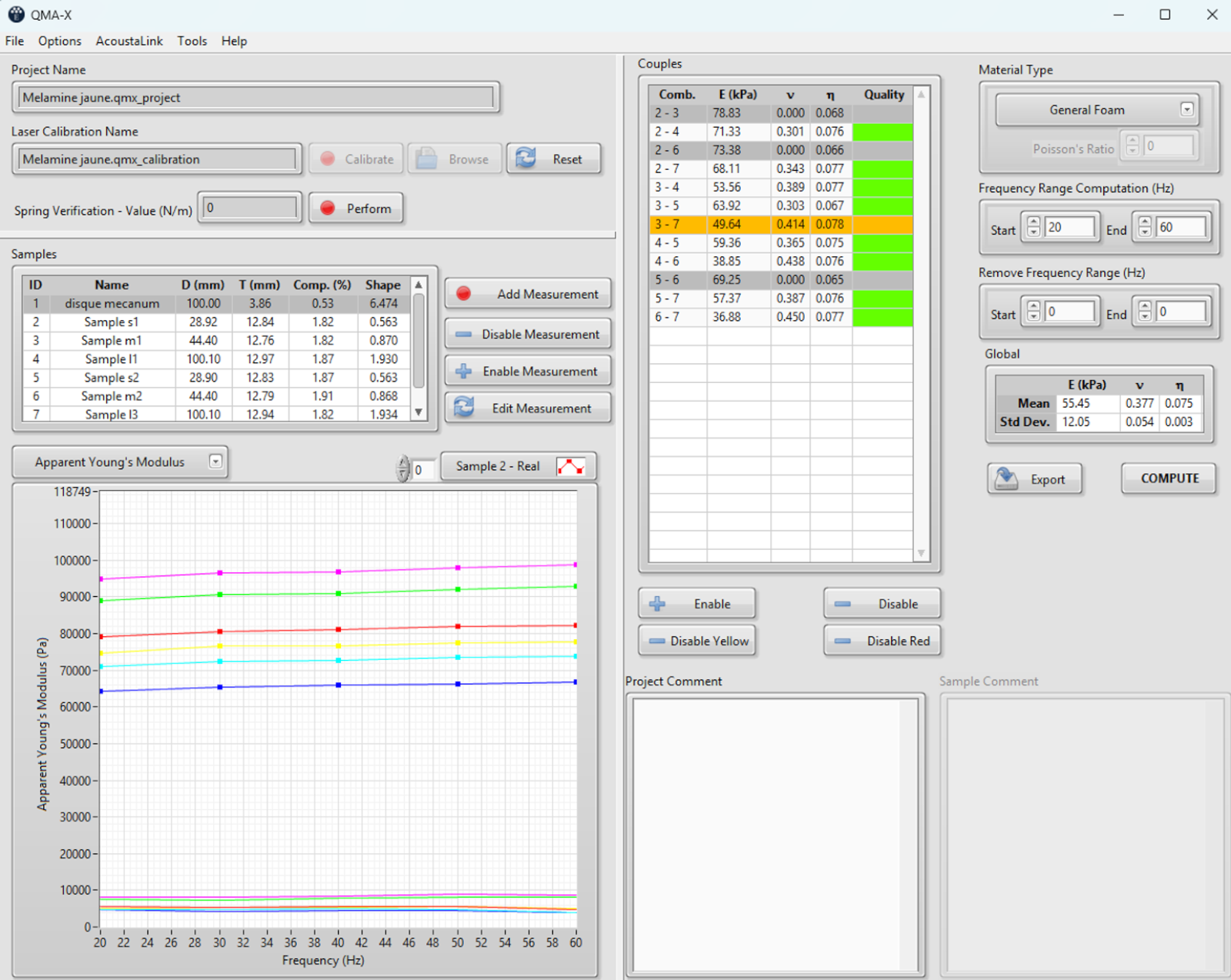
Coming soon.
Automotive industry
Characterize the elastic and damping behavior of porous materials that drive vehicle NVH performance.
Aerospace industry
Measure the Biot mechanical properties of lightweight porous materials for accurate structural-acoustic modeling.
Material manufacturers
Test Young’s modulus, Poisson’s ratio, and damping at the end of the line to guarantee material and process consistency.
Building
Characterize the elastic and damping properties of insulation and soundproofing materials used in construction.
Laboratories
Measure the full set of Biot elastic properties on small samples with a standardized, guided procedure.
Universities
Teach and research the mechanical behavior of porous media, from the elastic parameters behind poroelastic models.
Optional accessories, available with your quasi-static mechanical analyzer or separately.
Circular knife
The circular knife lets you cut clean, repeatable sample geometries from porous materials, so each specimen fits the tube precisely and edge effects stay minimal. Consistent sample preparation is one of the simplest ways to improve measurement repeatability.
Material slicer
The material slicer holds a porous sample firmly in place while you cut it to thickness, giving you flat, parallel faces and a controlled height. It removes much of the guesswork from preparing soft or compressible materials that are otherwise hard to slice evenly.